Cricket Australia chief executive Todd Greenberg has put a neutral-site Ashes Test in India into public conversation, while making clear that no such fixture is being planned. Speaking to BBC Sport on 23 July 2026, Greenberg said the concept was open for consideration. Any move would require agreement from the England and Wales Cricket Board and the Board of Control for Cricket in India, and neither board has committed to it.
The distinction between an idea and a scheduled match is the central fact. Greenberg did not announce a bid, a date or a venue. He described a possibility that the three boards could examine as they look for ways to strengthen Test cricket and create more international cricket activity in India. That is notable because the Ashes has traditionally belonged to England and Australia, not to a neutral market.
“It’s not something that we are planning, but it’s open for consideration,” Greenberg said. “We’d have to be open to considering all options.” His choice of words leaves the door open without moving the proposal onto a calendar. It also places the decision beyond Cricket Australia alone.
What Cricket Australia has actually proposed
The public position is narrower than the headline idea may suggest. Cricket Australia is willing to consider staging an Ashes Test on Indian soil in the future. The ECB would have to agree because England is the other side in the contest, while the BCCI would have to agree because India would be the host. No one in the reported exchange said a full Ashes series should move, and no one confirmed that one Test has been selected for relocation.
Greenberg linked the possibility to Cricket Australia’s relationships with both boards. “Our relationship with the ECB and the BCCI is very strong and clearly there are opportunities in India to put more content in certain areas,” he said. The remark frames India as a place where the boards may collaborate, rather than as a replacement home for either national team.
That matters for how the proposal should be read. An Ashes Test in India would be an agreement among three national boards, not a unilateral Australian initiative. It would also ask England and Australia to decide whether the reach of a neutral event outweighs the value of keeping every Ashes match in the countries whose supporters have sustained the rivalry.

Why a neutral venue would alter the Ashes tradition
The Ashes has been defined by reciprocal hosting. England and Australia meet in five-day cricket through a series that moves between the two countries on a cycle of roughly four years. Home crowds, familiar grounds and local conditions are part of the contest’s sporting identity. Taking even one match to India would break that bilateral pattern.
A neutral Test would change more than the address. It would remove one home match from either England or Australia, depending on which series supplied the fixture. That would affect the supporters who ordinarily attend, the ground chosen for the original schedule and the host board responsible for staging the match. The source report does not say how any of those questions would be resolved.
The unusual idea arrives when England and Australia have already accepted one departure from the usual series structure. They are scheduled to play a standalone Test at the Melbourne Cricket Ground in March 2027 to mark 150 years since their first Test meeting. That match stays in Australia, but it shows the boards are prepared to create a one-off event outside a standard five-Test Ashes series when the occasion is sufficiently specific.
India would be a more substantial departure. The MCG anniversary match is tied to the place where the first Test between the countries was played. An Indian fixture would instead be built around a neutral audience and a three-board partnership. Those are different rationales, even though both ask England and Australia to step outside the ordinary Ashes timetable.
The three-board test for any India fixture
Cricket Australia can make the suggestion, but it cannot deliver the match by itself. The ECB’s agreement would be required before England surrendered a home date or joined an Australian home series at a neutral venue. The BCCI’s agreement would be required to place the match in India and coordinate an Indian ground, local operations and the calendar.
The proposal therefore has three separate interests to satisfy. Cricket Australia has to see value in sending one of its highest-demand contests abroad. The ECB has to reach the same conclusion from England’s side. The BCCI has to decide that a neutral five-day match merits space and attention in a market already crowded with international cricket and the Indian Premier League.
Greenberg’s description of the relationships as strong explains why the thought can be discussed. It does not show that a negotiation has started. A relationship can make a proposal possible without making it probable. Until the ECB and BCCI state their positions, the only confirmed institutional view is Cricket Australia’s willingness to consider the concept.

Why Cricket Australia is looking toward India
The Ashes comment sits beside another confirmed Cricket Australia move. Melbourne Renegades are due to face Perth Scorchers in Chennai in December 2026, taking a Big Bash League match abroad for the first time. The event is not an Ashes rehearsal, but it shows the board is prepared to test Australian cricket content in India rather than treating the market only as a destination for national-team tours.
A domestic T20 match and a neutral Test pose very different questions. The Chennai BBL fixture involves two Australian clubs and a short format that fits the viewing habits the source report identifies as dominant in India. An Ashes Test would involve two national sides over five days and would ask neutral spectators to invest in a rivalry from which India is absent.
That contrast is useful. If the BBL event is staged as scheduled, Cricket Australia will gain direct experience of operating one of its competitions in India. It will not prove demand for the Ashes, because the format, teams and duration are different. It will simply provide a nearer example of how Australian cricket travels when the contest is presented to an Indian audience.
Greenberg argued that Test cricket among Australia, England and India remains strong despite pressure on the format elsewhere. “I think Test cricket between us, India and England is very strong and probably bucking the trend in some other parts of the world,” he said. “We want to make sure we grow and strengthen it.” His case rests on the combined attraction of those three countries, even though India would not play in the proposed match.
The audience question is larger than stadium capacity
The strongest uncertainty is whether Indian spectators would sustain interest in a neutral Test for five days. The source report notes that shorter formats, especially T20 cricket and the IPL, have increasingly dominated fan attention in India. It also raises the challenge of attracting a neutral crowd to a contest in which the Indian team has no direct role.
Novelty could help the opening days. England and Australia remain leading Test teams, and the Ashes carries recognition well beyond its two home countries. Yet a five-day crowd cannot be assumed from the name alone. A neutral Test asks spectators to follow a long contest without the national allegiance that ordinarily drives attendance.
The venue would sharpen that problem. The report identifies Ahmedabad’s Narendra Modi Stadium, with a listed capacity of 132,000, as a possible location rather than a confirmed choice. Filling a ground of that scale across five days would be difficult even for many matches involving India. Empty sections would be particularly visible in a fixture presented as an attempt to demonstrate the reach of Test cricket.
Capacity is not the only measure of success, but it would shape the event’s appearance and atmosphere. A smaller ground might create greater density; Ahmedabad would offer scale and symbolism. No venue decision exists, so those are staging questions rather than reported plans.

What the players would carry into a neutral Test
For the teams, the proposal would move a familiar contest into unfamiliar conditions. England and Australia would still bring the same rivalry, selection debates and five-day demands, but the pitch, climate and crowd relationship would no longer favour a conventional home side. The source report does not specify what surface would be prepared or how either squad would be selected, so any detailed tactical forecast would go beyond the confirmed record.
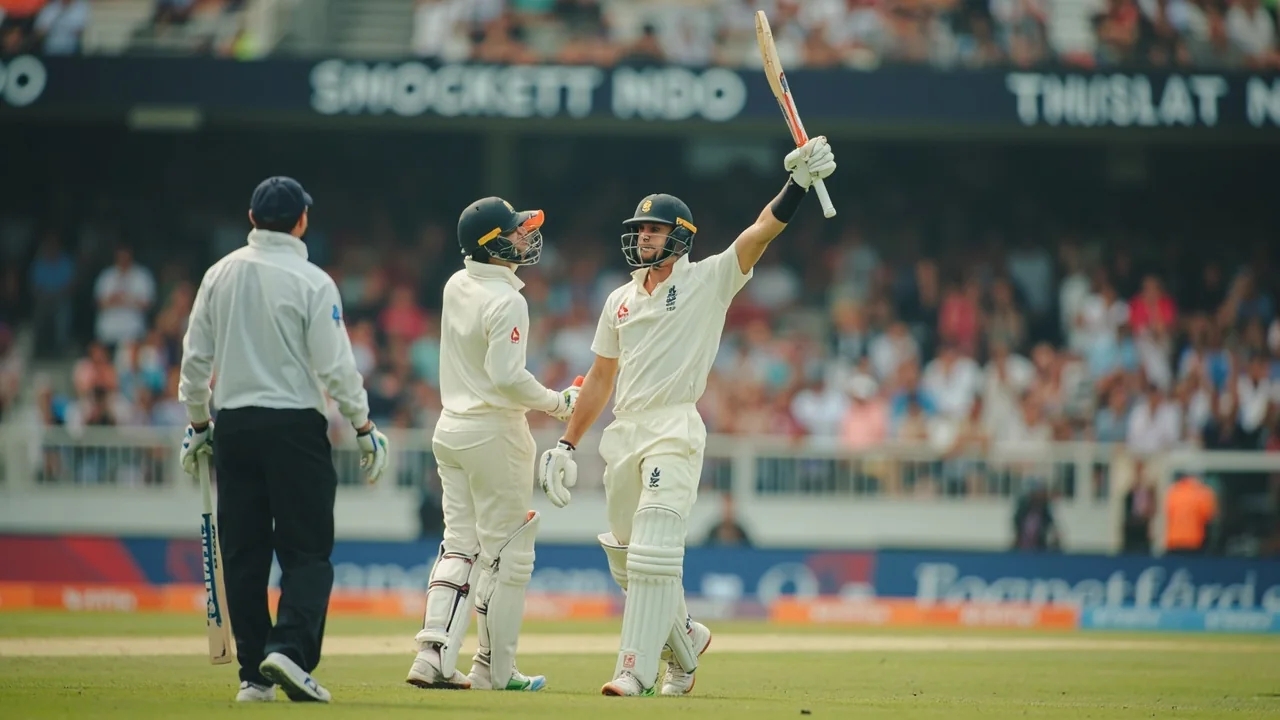
One named player connects the proposal to the current Ashes cycle. The report’s lead image showed Australia batter Travis Head celebrating a fifty against England in Perth during the first Test of the 2025/26 Ashes. His inclusion illustrates the existing contest, not a confirmed lineup for India. No squad, player commitment or selection plan has been announced for a neutral fixture.
The broader sporting question is whether neutral conditions would enrich the rivalry or dilute its home-and-away character. An Indian surface could reward a different balance of batting and bowling, but the specific effect would depend on a venue and pitch that do not yet exist in a schedule. The only safe conclusion is that neutral conditions would remove the usual home setting from both teams.
For readers following how leadership, roles and team balance shift with conditions, the broader players and teams analysis provides the relevant frame. In this case, however, the administrative decision comes first. Players cannot prepare for a match until three boards have turned a possibility into a fixture.
What has to happen before the idea becomes real
The proposal needs a sequence of decisions that has not begun publicly. First, Cricket Australia and the ECB would have to agree that an Ashes Test can leave its normal host country. They would have to decide which future series supplies the match and what happens to the original venue. The BCCI would then have to accept the event and help place it in India’s calendar.
After that would come a venue, dates, ticketing and broadcast arrangements. The five-day format would need a period that works for all three boards and does not collide with existing commitments. None of those details appears in the report, and none should be read into Greenberg’s invitation to consider options.
The March 2027 MCG anniversary Test is already fixed. The December 2026 BBL match in Chennai is already scheduled. Those are the two concrete events around the discussion. The Ashes-in-India concept remains separate from both, without a date or formal approval.
The next signals worth watching
The clearest next development would be a public response from either the ECB or BCCI. Agreement in principle from both would move the idea beyond Cricket Australia’s interest. A proposed season, host series or venue would move it further. Without those signals, the concept remains an option raised by one board’s chief executive.
The Chennai BBL match in December 2026 will also be relevant, although it cannot answer the Test-demand question on its own. It will show how Cricket Australia’s first overseas domestic fixture is staged and received in India. The standalone MCG Test in March 2027 will show how England and Australia handle a special event outside the standard Ashes series.
For now, the significance lies in the willingness to discuss the previously unlikely. Cricket Australia is not planning an Ashes Test in India, and no fixture has been announced. Greenberg has nevertheless said the board would consider it, subject to the ECB and BCCI. The next meaningful step belongs to those two boards, not to speculation about a date or ground.